|
|
|
The midterm examination will consist of 6 short answer questions, of which you will need to answer any four, and two essay question, of which you will choose one to answer. Sample Short Answer Questions: 1. Define environmental health and describe one way in which the practice of
environmental health is relevant to your own life. 2. Name one choice that you have made in the past week that has had
a negative impact on the environment. Explain what the negative impact
was. Then name one choice that you have made in the past week that
has had a positive impact on the environment and explain why? 3. Ecologists artificially divide the total environment into a series
of regions or spheres for analytical purposes. 4. Define the terms
distribution and determinants of disease in human populations and
name at least one important human characteristic that influences
each of these. 5. List two important limitations of epidemiology, and explain how one of these limitations affects the interpretation of results of an epidemiologic study.
7. Briefly describe the dose-response relationship and explain
why it is a fundamental principle of toxicology. 8. Identify the four basic methods or approaches used in hazard identification in toxicology studies. Give one advantage and disadvantage of each. 9.
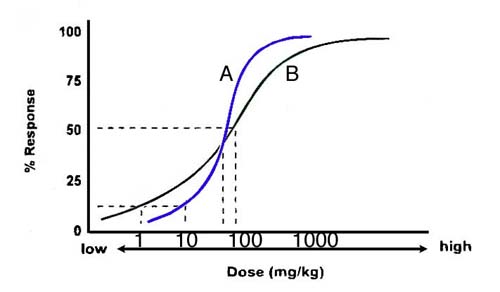
The dose-response curves for to chemical compounds below are
based on animal studies in controlled laboratory settings.
11. List four of the six criteria pollutants designated under
the Clean Air Act of 1970 and identify the major sources and
the health
effects of each pollutant. 12. What is a temperature inversion? How does it occur? How
are the health effects of air pollution aggravated by such
an occurrence? 13. Describe the hydrologic cycle and explain why is it important
to the practice of Environmental Health? 14. Most water used for drinking purposes is disinfected before
consumption. Briefly describe the common substances and/or
processes used to disinfect
drinking water and an advantage and disadvantage of each. 15. Explain the difference between primary and secondary municipal
sewage treatment processes. List each element and their function
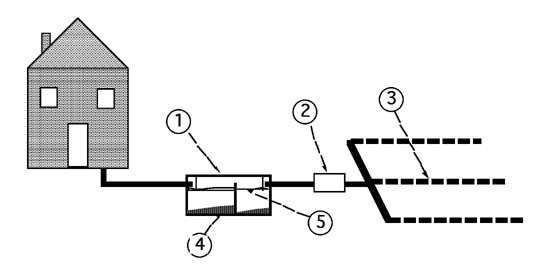
in your answer. 16. For people living in rural areas municipal sewage treatment is usually not feasible. These families typically must dispose of their sewage on their property. A typical on-site sewage system is depicted below. Identify the five major component parts of the system and explain the purpose of each, and then explain how the system as a whole, serves to prevent pathogenic organisms present in sewage from coming into contact with human populations.
17. Name the agent,
host, reservoir and vector for one disease and explain how
each of these
work together in the transmission of this disease. 18. What is Integrated Pest Management? Explain how pesticides
can play a role in an integrated pest management approach
to controlling mosquito vectors of disease. (You may draw
on the
lectures, your
text book and reading 4 to support your answer.) 19. What is the difference between a food-borne infection and
a food-borne intoxication? Name one example of each. 20. Describe the four most significant problems which lead to the spread of a foodborne illness, and indicate what needs to be done to prevent these problems Sample Essay Questions:
2. In the 1960s, Dr. Paul Erhlich
and other eminent scientists predicted that at the then current rate
of world population growth and the increased consumption of natural
resources by all societies that the Earth is rapidly approaching
the point of collapse. Almost 40 years have passed since the publication
of Erhlich’Äôs book The Population Bomb. Critique the ’ÄúLimits to Growth’Äù
Model explaining why you believe the model is or is not supportable.
Support your answer with evidence from your readings in this course
and materials from the course lectures. 3. Select a recent news article to "analyze" and discuss in terms of the major concepts that you have learned so far. That is look at the issue from a critical thinking perspective, determining the environmental and public health issue(s), the stakeholders, and the overarching concepts involved. Your answer should identify the agencies/regulations that might be part of the issue. Look at the Epidemiological evidence ’Äì what it can and can not tell the relative risks to the various stakeholder populations and how good a job of Risk Communication the lead agency has done.
|
||
|
Send mail to:
ctreser@u.washington.edu
Last modified: 1/04/2005 \ 8:39 pm |