|
||||
Mapping Project: Due Monday, 12_03_2007 |
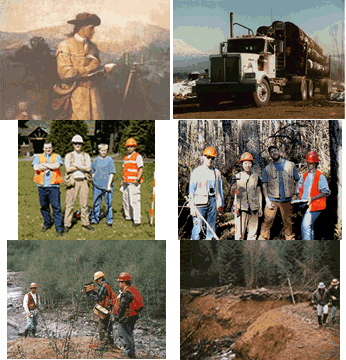

Collect necessary information about a five-sided traverse that allows you
to calculate the area.
In the filed, measure distance and compass bearings between the marked
points. Also record the GPS
coordinates for each marked point
Moving from the field with your collected data/measurements to the office the following work is left: plot the collected information to a suitable scale
Procedure (performed by each group) If you are knowledgeable with some
software packages (AutoCAD, GIS, etc) you can also enter the
1. Calculate interior angle error and adjust the interior angles
2. Recalculate the azimuths of each line
3. Calculate the latitudes and departures and coordinates for each point
4. Use the coordinates to plot your traverse (select an appropriate scale)
5. Establish (measure) your EOC
6. Balance your traverse graphically and scale off the corrected coordinates for each point
7.
On the plot, label each line segment with its Distance and
Azimuth, each point with its coordinates.
8. Calculate the area of your traverse
9. Each group turns in a report that shows
- graph with the original traverse and the graphically adjusted/balanced traverse
- calculations showing original (uncorrected) and balanced (corrected) coordinates
- your error of closure (EOC) and precision reported as a ratio (1: xxx)
- area of traverse in
acres
- compare coordinates from the GPS unit with your field-based coordinates
- comment on the findings. You
may also try to establish coordinate data from digital orthophoto
images (load it up in ArcGIS) available from the
Map Library (city of