Analysis
Our data was gathered from the Census Bureau and it is important
to know that as time past, more census tracts added to match the amount of growth
the city has had over the past 40 years. These added census tracts help us see
how much urban development has occurred in the short amount of time. Almost
every aspect of our study shows an increase mainly because of the added census
tracts and the expanding city. It is also good to keep in mind that we took
the median of all the data we received to make it a little easier in our analysis.
(Click here
for another look at the maps and graphs)
When looking at the amount of growth in the city of Everett, it is interesting
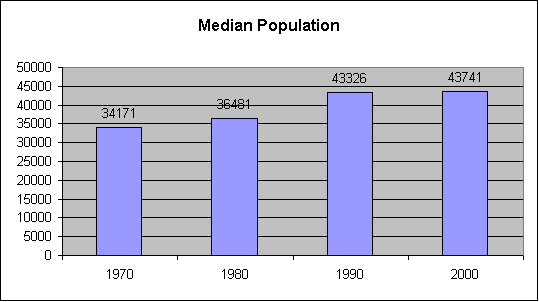
to see how much the population has changed over the years. The median population
has grown steadily over the years starting at 34,171 in 1970 and steadily rose
to its current number, 43,741. There was a slightly higher increase between
the 1980 and 1990 dates because of many factors. This includes the introduction
of many new industries to the area and the increasing economy that comes with
that.
When I looked at the median amount of occupied housing it was interesting to
see the great jump from 1970 to 1980. The number jumped from a very small 3,529
to 25,514. It made an equal jump again between the next two dates in much the
same way. It is easy to see the amount of development that has occurred in the
short amount of time. When looking at housing, I find it more important to look
at the amount of vacant housing in the area. It is surprising to see that the
largest amount of vacant housing was in 1980. This suggests that in that time
period, a great amount of development was occurring and more houses were being
built compared to the number of people moving into the area.
The last two variables we looked at was the amount of renters and the amount
of owners in the Everett area. I was interesting in looking at the ratio of
owners to renters and seeing which was higher, and try to come to a conclusion
as to why this is. I looked as the data as a comparison between renters and
owners for each year rather than the change between years. I did this because
the median data does not give an accurate amount over the years. This is because
industrial areas produced a really low number and other tracts were only housing
and that produced a really high number. So because of these factors, the median
numbers are not as accurate. It is easy to see that the amount of renters is
greatly higher compared to the amount of owners. For each year, there was always
10 times as many renters as there was owners. There can be many factors that
contribute to this. One of these factors is the lack of job security in the
area, and with the many job layoffs in the area, many people opt to rent as
to not limit themselves should layoffs occur.
 |
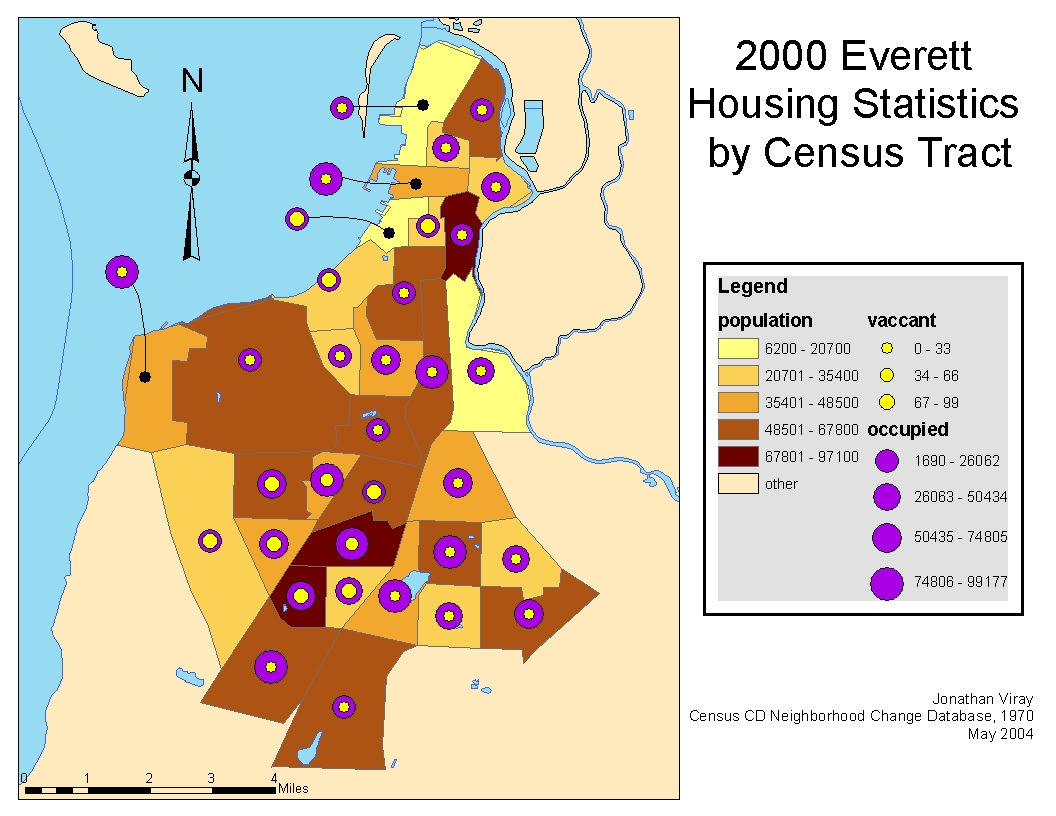 |
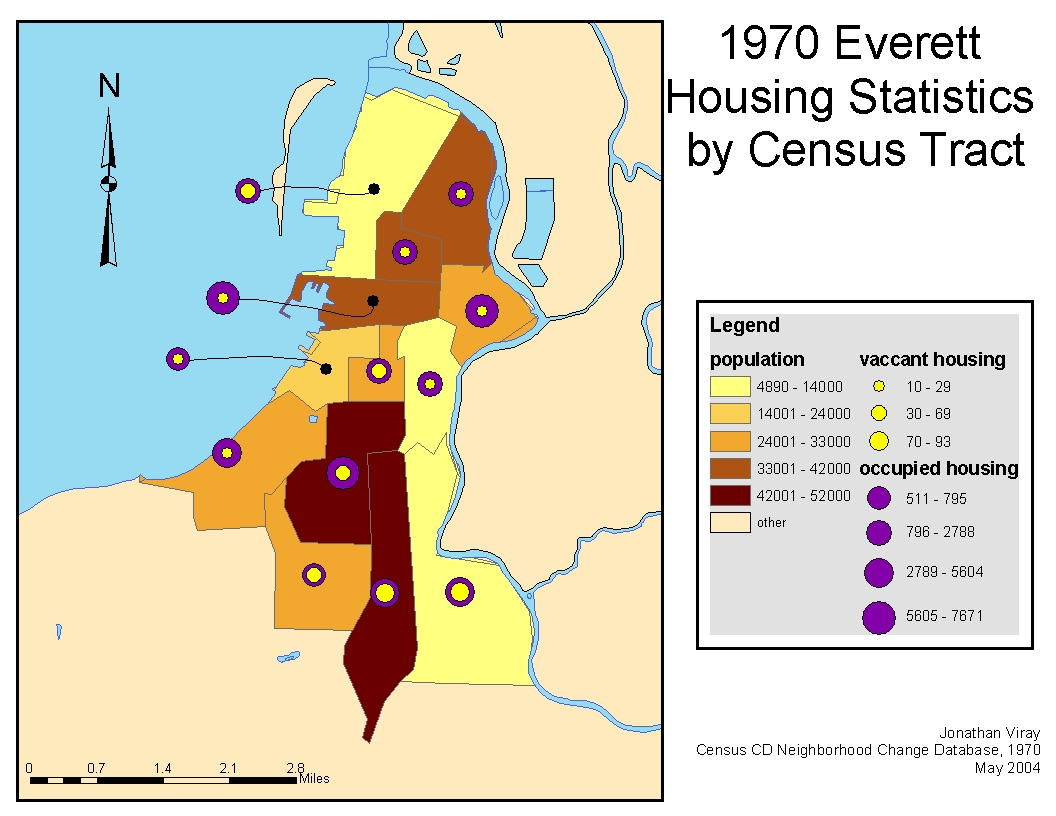
When I looked at the data on the maps, it was easy to see that the city growth
was expanding southward. Unlike other areas where space is limited, there was
a lot of room for growth south of the original Everett peninsula. This resulted
in the expansion of the city southward.
There are many other studies that address the Urban growth of cities. This can be supported by many other studies and programs that are looking at the same problem. One article I found to be particularly interesting was this one. The article talks about Everett and what has happened in its Urban growth.
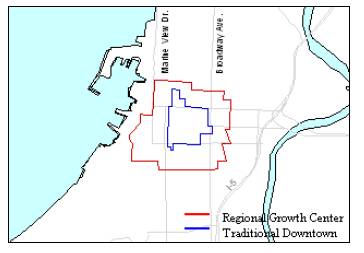
As you can see from the map, the downtown are has expanded outward from the
original plan. This causes a problem because the housing and other buildings
in the original area get abandoned because of this outward expansion This relates
to this project because much in the same way that it is happening in the downtown
area of Everett, it is also happening in the various communities of Everett.
It seems that the further you move away from the city center, the more expensive
the houses are and the greater the mean income is for those areas. So you get
this problem of increase in amount of current housing because people are moving
out. In a good way this creates affordable low income housing without having
to build new structures. This is what happened in downtown Everett. The problem
with that is sometimes the houses that are left are in no shape to live in.
So they sit there and there is no use for them. In the article, the author talks
about the challenges in beautifying the area and removing all the rundown housing.