
Design of Oceanographic Field Experiments

The primary function of OCN 443 is to provide guidance for the formulation of your research proposals and for timely cruise planning of the OCN 444 field work that will take place in January. The multi-faceted goals of OCN 443 are (1) to familiarize you with common strategies and methods in field oceanography (emphasizing collaborative and interdisciplinary approaches), (2) to encourage critical interpretation and presentation of arguments and data, and (3) to learn about the Galapagos Islands and oceanographic processes associated with them. You will have principal responsibility for selecting a research topic/goal and then planning, executing, and reporting on your work. Experience tells us that you will enjoy this unique opportunity to develop your scientific skills in a real world framework.
The key to success in OCN 444 is solid preparation in OCN 443. Your individual responsibilities for fall quarter are (1) to produce a detailed research proposal testing a hypothesis using the best possible experimental/observational strategy, given the limitations in time and available equipment, (2) to post your final proposal on your personal web site, and (3) to assist in the cruise planning (schedule, logistics, etc.) for the platform(s) that will be used. The combination of background research, proposal writing, cruise planning (OCN 443), the research cruise itself, paper writing and the class symposium (OCN 444) is what makes this capstone course sequence such a unique, rewarding, and educational experience. The focus on the Galapagos Islands additionally provides an unusual and exciting opportunity to study the complex interactions between physical, chemical, geological and biological processes associated with three of the world's major current systems, not to mention a historical crucible for biological theory. Finally, you will also have the opportunity to interact with Ecuadorian oceanographers, including some from the Darwin Research Station on the Galapagos Islands.
OCEAN 443 will meet three times a week in 205 OTB: from 1:30 to 2:50 on Tuesdays and Thursdays, and from 1:30 to 2:20 on Fridays.
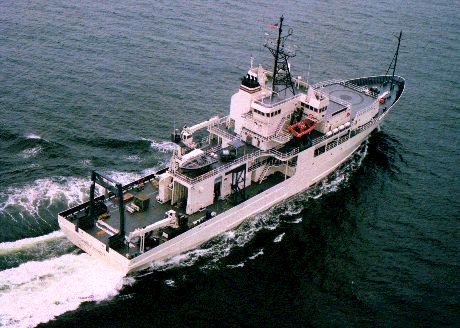
Fieldwork is tentatively scheduled for two separate periods aboard the R/V Thomas G. Thompson: January 12-20 and January 21-29, 2006. Although dates may change slightly, current planning has students leaving Seattle on January 9th to participate on the first leg and returning to Seattle on the 22nd, while those on the second leg will leave on the 17th and return on the 30th. Inevitably fieldwork will require you to miss classes at the start of winter quarter; you should begin planning for that now and remember to make appropriate arrangements with the instructor(s) to make up any missed work. Thompson will be operating in and out of Puerto Ayora, Santa Cruz Island, Galapagos, during the fieldwork periods mentioned above. Due to the logistical difficulties of field work several thousand miles away, flexibility will be more limited than in previous years (when research has been conducted in Puget Sound) and careful cruise planning will be necessary, both to provide adequate research opportunities to all class members and to coordinate with Ecuadorian scientists joining us on the cruise.
If you haven't done so already, it will also be necessary to have a current passport and appropriate immunizations (in particular, for Hepatitus A and tetanus) and medications (sea-sickness, anyone?) for travel abroad and at sea. For more specific information, look at the CDC website or get an appointment with the Hall Health Travel Clinic (which we highly recommended well in advance of the cruise: according to Hall Health, appointments should be NO LATER than 4 weeks prior to departure).
The dramatic confluence of major current systems, topographically-induced upwelling, and island inputs found around the Galapagos presents a wide array of challenging oceanographic conditions and phenomena that can form the basis of very interesting research projects. In choosing your research project, we encourage you to think in terms of a team approach that crosses option boundaries. More useful insight can usually be gained if a problem is viewed and understood from multiple perspectives. This approach may also provide valuable experience as you enter the job market or graduate school.
In OCN 443, each of you will be responsible for a written research proposal (see Handout #3) that lays out a scientific rationale, a cruise/analytical work plan, and a budget. Copies of some proposals from previous years are on reserve in the Fish-Ocean library. Your advisers may have additional copies for short-term loan. To assist you in keeping on pace, additional assignments (article discussions and Milestones 1, 2 and 3) are designed to help you develop good organizational skills, read the scientific literature critically, and write and argue persuasively. Although we will work together to identify and read appropriate literature (particularly in the first four weeks of class), it will also be necessary throughout the fall quarter for you to do your own literature review to find material relevant to the research you want to do. Helpful guidelines for literature reviews can be found at article discussions; you should also examine the class reading list, many articles of which are available through library reserve, including in downloadable form on the electronic reserve. Other useful information, including data from moorings and drifters in the Equatorial Pacific, are available to the public; see links. Your final proposal should reflect your review of the literature with a critical discussion of published work related to your proposed research (including appropriate citations and references). Additionally, all of you will assist, during formal class exercises, in formulating a detailed cruise plan for the ship and vessels that will be used and for ensuring that research vessel time is partitioned adequately and fairly. Prior to any cruise work, you will also be responsible for ordering necessary supplies and expendables, seeking out the equipment you need, and mastering necessary shipboard measurement techniques.
Your grade in OCN 443 will be derived from the following components:
| Assignment | Due | Grade Weight |
| Participation in cruise planning, preparation and loading | (whole quarter) | 5% |
| Participation in article discussions and the peer review exercise | (whole quarter) | 10% |
| Milestone 1: Interactions of physical, chemical, geological and biological processes around the Galapagos Islands | 10/14 | 5% |
| Milestone 2: Proposal theme (MS Word, 45 KB) | 10/21 | 10% |
| Milestone 3: Experimental plan and rationale (MS Word, 67 KB) | 11/1 | 15% |
| Milestone 4: Individual Ship Time Requests (MS Word, 55 KB) | 11/8 | 5% |
| Milestone 5: Draft Proposal | 11/22 | 20% |
| Milestone 6: Final Proposal | 12/9 | 25% |
| Milestone 7: Web posting of complete proposal | 12/14 | 5% |
Note: Deductions of 2 points per day will be made for late submissions. A passing grade in OCN 443 and admission to OCN 444 are contingent upon submission of an acceptable proposal demonstrating that you are thoroughly prepared for the research cruise.