The textbook is:
Michael
W. Passer & Ronald E. Smith
Psychology: The Science
of Mind and Behavior.
5th Edition
(Copyright is 2011)
**There are 4 versions (paperback, looseleaf, hardcover, e-book). The versions that the U.W. Bookstore will have available at any given time may vary.
Any one of these versions is fine -- YOU ONLY NEED ONE VERSION -- but they have different short- and long-term costs for you, which I will explain below.
USED or NEW is fine, for the paperback, looseleaf, or hardcover. There are no used versions of the e-book.
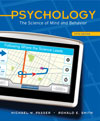
THE COVER of the paperback, hardcover, and e-book is blue with yellow lettering and large photo of GPS device with roadmap, says "5th edition". I have not been informed as to whether the looseleaf will have a cover like this.
The paperback cover also will say something like "custom edition" and "University of Washington".
Can I use an earlier edition? I advise against it; click for reasons.
Can I use a "used copy" of the 5th edition, rather than a new edition? Absolutely; a used copy will be the less expensive approach.
1) U.W. Custom Paperback Edition:
This is the 5th edition
(2011)
ISBN-13: 978-0-07-747280-1 (this IS the ISBN, but you may not turn it up with an electronic search)
Less expensive than the hardcover edition (new vs. new, used vs. used).
There are two differences between this and the hardcover edition:
a) The cover is paperback.
b) It has 13 chapters. Four chapters have been deleted from the regular version of the textbook because we will not be covering them in class (Chap 9, Language & Thinking; Chap 10, Intelligence; Chap 11, Motivation & Emotion; Chap 14, Health & Well Being). This reduces the cost of the book, making a new paperback about $30 less expensive than a new hardcover book.
2) Looseleaf version of 5th edition (2011): Cheaper way up front to purchase a new book, but you should check with the U.W. Bookstore to verify whether you will be able to sell it back to the Bookstore after the course is done. I believe that looseleaf version is the complete version of the book (17 chapters: the 13 chapters we will cover plus the 4 chapters we will not cover). However, if it is 13 chapters, that's OK, as long as the missing chapters are Chapters 9, 10, 11, and 14.
3) Hardcover:
This is the 5th edition (2011).
ISBN: 978-0-07-353212-7
This books contains all 17 chapters and is sold nationally. If you cannot get a copy of the custom paperback or looseleaf edition then a USED or NEW hardcover edition is fine. It contains all the readings you will need for the course. If the UW Boostore does not carry the hardback and you decide you want a hardback book, search online for a bookseller like Amazon or Barnes & Noble or ask the UW Bookstore if you can order a copy. Apparently, you can rent a copy of the hardcover book from the bookstore: see this link (type "Passer" in the search window).
4) E-book version. 5th edition (2011) of the hardcover book: Cheaper way up front to purchase a new book, but see below. To buy an e-book you can get an access code card in the textbook section at the U.W. Bookstore, order it online from the U.W. Bookstore's website, or get it online from CourseSmart.com.
Short vs. Long-term Costs: At the time you purchase a book, an e-book or rental or looseleaf version probably will be less expensive than a new paperback custom book or a new hardcover book, although it may not be less expensive than a used hardback or custom book. Prices change each quarter so you will need to check out the least expensive options on your own.
Note that when you buy a textbook from the U.W. Bookstore:
a) You eventually receive a 10% bookstore rebate (
according to the bookstore website), and
b) IF it is a HARDCOVER or PAPERBACK you most likely will be able to sell your book back to the bookstore at a reduced price, although you may have to wait 1 or more quarters until the book is used again by me or another instructor in an upcoming quarter. The Bookstore has told me that it does buy back LOOSELEAF versions as well, but you should verify this by asking a Bookstore employee (e.g., at the checkout counter) before you purchase it.
In any event, read the Bookstore policy about purchasing back textbooks in green below, then see my comments.
"
Does University Book Store buy used textbooks?
- "Yes. We buy textbooks at the main store year round based on national market value. However, during quarter finals, textbooks that will be used in the upcoming quarter will be bought back for up to 55% of the new book price, unless one of the following events occurs:
- The instructor has not requested the book for the next semester. (Textbooks that will not be used in the upcoming quarter will be bought back at market value.)
- We have already bought back as many copies of the book as we need.
- There is a more recent edition available.
- The book has no national market demand.
- The book is not in resalable condition"
In Fall 2013 Dr. Lois McDermott tentatively is scheduled to teach Psych 101, and she uses the same textbook that we are using (Passer/Smith Custom Edition, 5th edition). I will be using the textbook again in Spring of 2014. Therefore, at the end of Spring quarter 2013, you should check with the bookstore to see whether you will get a better buy-back price (hardcover or custom paperback only) at that time, or whether you should wait and sell it back to the bookstore later on, as spring quarter approaches next year.
QUESTION: IS IT OK TO USE AN EARLIER EDITION OF THE BOOK?
ANSWER: I STRONGLY RECOMMEND THAT YOU DO NOT USE AN EARLIER
EDITION. WHY?
First, as you know, we are using the 5th (newest) edition of a textbook of which I am one of the authors. Therefore, I want you to be aware that the following advice is what I have always given my Psych 101 students, even for the many years before I co-wrote this book and therefore was using books by other authors. This is also the same advice that I give to my Psych 209 students, a course in which I am not an author of the textbook.
For any course, I always recommend that the newest (latest) edition of the textbook be purchased -- either as a new copy or more cheaply as a used copy if used copies are available. Although most of the core content may remain the same, new content is always added to the latest edition, other content is deleted so that the book doesn't keep getting longer and longer, and there may be both major and minor changes within chapters. Graphs or diagrams to illustrate some concepts may change. In our case, all of these changes can be found in the 5th edition versus earlier editions. Finally, page numbers (such as may occur in the list of reading assignments, where in some chapters you would skip some pages) won't match up to the syllabus.
Thus, I cannot tell you that it's OK to use the older edition. For any new edition in any course you take, even if most of the content is the same, I'd hate to see a student miss items on an exam because the items focus on concepts, research findings, or examples covered only in the new edition (and not in older editions, nor even in lecture). In my own Psych 101 course, I typically base a good portion of exam questions (about 30% to 40%) on information that is covered in the textbook but that is not covered in lecture. In other words, I expect my students to read the book independently and carefully, and I do not use lecture to "try to cover everything" in the book, which would be impossible anyway. Rather, some class time is used for demonstrations, other exercises, and videos to illustrate important concepts or findings. Obviously, given the cost of textbooks and your particular financial situation, you will reach your own decision about which edition to buy, but I have to recommend against using an older edition. Several copies of the current edition of the textbook will be placed on reserve at OUGL (Odegaard Undergraduate Library, Reserve Desk).
Return to Textbook Version/Purchase Information
Copyright © 2005 The University of Washington. All rights reserved.