In lecture, you claimed that the conservation of momentum and energy between the initial and final states of the Newton's balls demo was inusfficient to uniquely specify the final state. OK, so what is the counterexample? If one ball moves in from one side with velocity vo, what might happen other than one ball moving off from the other side after the collision?
Consider the diagram below:
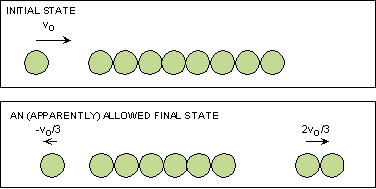
The initial state has momentum mv_o and total kinetic energy 0.5*m*v_o^2. The final state has the same momentum and also the same total kinetic energy. As I mentioned in lecture, you must consider the intermediate states in this multiple-collision problem to correctly predict the final outcome.