
Syllabus
print version
UW-B course catalog description
Explores the determining role of language in human communication, culture and worldview; and the implications of language structure and content to forms of communicative interaction. Review and critique of theories of language as a social phenomena.

course description
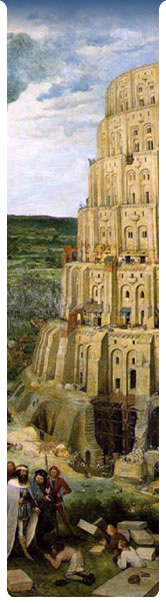
It is commonplace to identify complex language use as the trait makes humans distinct from other animals, but despite the idea that language connects us as human beings, in practice it is frequently used as a means of division. In the biblical account of the Tower of Babel, god divides humanity with different languages in order to foil their collaborative efforts to build a tower up into the heavens. In our daily lives it is people who do the dividing, making assumptions about a person's background—nationality, economic class, level of education, etc.—and often by extension their character—personality traits, moral principles, intelligence, etc.—based on the language they use. This tension between connection and division is at the heart of much concern with language that informs common attitudes toward linguistic diversity and language policy in the U.S. The primary goal of our shared inquiry this quarter will be to develop better understanding of what drives concern about miscommunication and what are the effects of this fear.
guiding questions
Over the quarter our work will follow trajectories guided by the following questions:
- What are the various ways the notion of communication has been conceptualized historically?
- How can we most usefully understand the relationships between language and thought?
- What is and can be the role of language in individual and national identity?
- How do people communicate across cultural and linguistic differences?
- How and why do languages change over time?
- What is the role of language policy in a democracy?
course objectives
By the end of the quarter successful students will have demonstrated—in class, through weekly course work, and in their final portfolio—the abilities to:
- Articulate a multifaceted understanding of the idea of communication
- Display rhetorical skill as a responsive and resourceful designer of meaning in multimodal and multilinguistic contexts
- Formulate questions and lines of inquiry that 1) synthesize or integrate different perspectives and approaches to constructing knowledge and 2) cultivate critical awareness of the ethical, cultural, and political dimensions of the ideas you encounter and explore
- Employ skills and strategies for effective collaboration as a learner, researcher, and teacher
- Address different audiences and contexts effectively, in speech and writing, both within and outside the classroom
- Articulate and assess the effects of the choices you and others (peers, scholars, and authors) make in writing and creative work
course experience
Class Meetings
This class will meet twice a week in person and also interact regularly on the online course discussion board (using Catalyst GoPost). Time in class will be spent primarily in conversational and collaborative learning through discussions, workshops, activities, etc. and will also include the occasional brief lecture. The way I teach typically calls on students to do something rather than just to hear or watch me do something. Your engaged participation will be required at every class meeting.
Collaboration
Much of the work for this class will require you to collaborate with classmates. Just as swimming is more than waving one's arms in the water, collaboration is not achieved just by working in groups. Collaboration means working together to solve problems, invent, create, build models, and produce results. For collaboration to happen, participants must see the different resources (information, cognitive styles, cultures, decision making authority, etc.) each has and know that they come together as equals to complete a task. This course emphasizes collaborative learning and the development of collaborative skills because when people collaborate they learn more, work harder, support one another, and commit to cumulative efforts and effects.
Technology
In addition to basic MS Office programs, course will likely require the use of several of UW's Catalyst tools, including GoPost (discussion board), E-submit (for electronic submission of papers), and ShareSpaces (for online collaboration). See the Catalyst website for more information on these tools. Depending on the choices you make for your term project, additional software and computer skills may become necessary to you. You do not need to feel expert with computers coming into this course, but you may need to be willing to learn new computer skills in order to be successful in this class.
Assignments
Close and timely attention to reading, writing, and other assignments is a requirement for the course. Prompt and satisfactory completion of every assignment is a precondition for passing the course. You can expect that we may have a quiz from time to time.
An assignment of some kind will be due for every class session, and you will need to establish the kind of work routines that will permit you to get the work done on time. I recommend that you set aside at least three large chunks of time, each three hours or more in length, per week to do the required work.
Because the assignments are designed to operate as a sequence, you will need to turn each in on a timely basis to benefit from, and contribute to, the cumulative process. It is not possible to "make up" class discussion, in-class writings, presentations, group work, or other in-class activities. As a matter of policy, late work will not be accepted for credit in this course, but all assignments must be turned in as a prerequisite to submitting your final portfolio. It will be your responsibility to keep track of your progress, avoiding late or missing work.
course documents & texts
Course Website
For each course that I teach, I design and maintain a course website where the course syllabus, schedule, assignment prompts, in-class materials, and related web resources are available to you online. The syllabus and schedule together provide a quite detailed course map that sets out the terms and pacing of our work together. I begin every course by asking class members to conduct a thorough reading of all course documents, and the syllabus in particular because it operates as the contract for our course. I will not be making major changes to the course content, workload, or expectations implied here (though minor modifications to the course plan may become necessary). By remaining enrolled in the course, you signal acceptance of the course terms as stated here and in other course documents.
It is a good idea to bookmark this site and refer to it regularly for information about the course. I recommend that you reread the syllabus entirely by the mid-term mark, because some of its particulars will become clearer only as you inhabit the course and attempt the kind of learning it asks of you.
Readings
Week 1: What We Talk about when We Talk about Language and Communication
- BIS 317 syllabus
- "Communication" and "Language." The Oxford Companion to the English Language. Ed. Tom McArthur. New York: Oxford UP, 1992. 238, 571-73.
Week 2: The Idea of Communication
- Peters, John Durham. "The Problem of Communication." Speaking into the Air: A History of the Idea of Communication. Chicago: U of Chicago P, 1999. 1-31.
- recommended: Greenblatt, Stephen J. "Learning to Curse: Aspects of Linguistic Colonialism in the Sixteenth Century." First Images of America: The Impact of the New World on the Old. Ed. Fredi Chiappelli. Berkeley: U of California P, 1976. 561-76.
Week 3: Language, Thought, and Worldview
- Duranti, Alessandro. "Linguistic Diversity." Linguistic Anthropology. Cambridge: Cambridge UP, 1997. 51-83.
- recommended: Gill, Jerry H. "Language and Reality: The Work of Benjamin Lee Whorf." If a Chimpanzee Could Talk. Tucson: U of Arizona P, 1997. 124-43.
Week 4: Language and Nation
- Anderson, Benedict. "The Origins of National Consciousness." Imagined Communities: Reflections of the Origin and Spread of Nationalism. Revised ed. London; New York: Verso, 1991. 37-46.
- Simpson, David. "Founding Fathers and the Legacies of Language." The Politics of American English, 1776-1850. Oxford: Oxford UP, 1986. 29-51.
- recommended: Bourdieu, Pierre. "The Production and Reproduction of Legitimate Language." Language and Symbolic Power. Trans. Gino Raymond and Matthew Adamson. Ed. John B. Thompson. Cambridge: Harvard UP, 1991. 43-65.
Week 5: Language Ideology
- Lippi-Green, Rosina. "Language Ideology and the Language Subordination Model." English with an Accent: Language, Ideology, and Discrimination in the United States. London; New York: Routledge, 1997. 63-73.
- Anzaldua, Gloria. "How to Tame a Wild Tongue." Borderlands/La Frontera: The New Mestiza. San Francisco: Spinsters/Aunt Lute, 1987. 75-86.
Week 6: Intercultural Communication
- Rubin, Donald L. "Composing Social Identity." Composing Social Identity in Written Language. Mahwah, NJ: Lawrence Erlbaum Associates, 1995. 1-30.
- recommended: Scollon, Ron, & Suzanne Wong-Scollon. "Conversational Inference: Interpretation in Spoken Discourse." Intercultural Communication. London: Basil Blackwell, 1996. 50-73.
Week 7: Contact Languages and Language Varieties
- McWhorter, John H. "Some Languages are Crushed to Powder but Rise Again as New Ones." The Power of Babel: A Natural History of Language. 131-76.
- recommended: Wolfram, Walt, & Natalie Schilling-Estes. "Dialects in the United States: Past Present, and Future." American English: Dialects and Variation. Malden, Mass.: Blackwell Publishers, 1998. 91-124.
Week 8: Language Policy and the Dream of a Common Language
- Tollefson, James W. "Language Policy and Democracy." Planning Language, Planning Inequality. London: Longman, 1991. 201-12.
- The English Language Unity Act of 2007 (H.R.997).
- recommended: Mencken, H. L. "The Future of English." Harper's Magazine 299.1792 1999 (1935).
Week 9: Language and Communication in Everyday Life
- Coppola, Sofia. Lost in Translation. Focus Features, 2003.
Week 10: Wrapping Up
- no required readings
should you take this course?
There are many ways to meet your degree requirements, so it is important for you to choose each course wisely. Sometimes practical constraints (such as time slot and the like) play a part in your decisions, but these should not trump choices based upon the learning prospect. No course is right for everyone, but only you can determine if a particular course is appropriate for you.
This class is likely to work well for you if you are motivated to:
- take responsibility for your own learning
- hold yourself accountable for your choices
- interact, question, respond, and introspect
- deal constructively with complexity, ambiguity, uncertainty, ambivalence, and nuance
- contribute to shared inquiry as conducted by a community of learners, and
- be ever receptive to, and resilient in, intellectual risk-taking.
This class is not likely to work well for you if:
- you desire a survey course where in-class coverage of text-book material is the central value
- you prefer lecture courses
- you like to remain anonymous in the classroom
- you decline to participate in class discussions and activities
- you aren't comfortable (or willing to get comfortable) using technology in and out of the classroom
- you want to interact only with the instructor (vs. peers)
- you expect to be successful on the first attempt at a skill
- you dislike reading and/or writing
- you are uncomfortable with readings representing adult situations or strong/coarse language
- you like best a class where questions can be settled and facts confirmed, or
- you are more concerned with your grade than with what you learn.
assignment overview
The following is intended to give you an idea of the assignments we'll be working on this quarter. Detailed information about each assignment's requirements will be given in class and available in written form.
Preparation & Participation (40%)
Participation includes thoughtful preparation for reading discussions, active engagement in in-class activities, productive collaboration with classmates, and so on.
Microessays
A microessay is a highly compact single-spaced, single page essay. The idea behind the microessay is to grab some things that interest you from the readings and throw yourself into articulating a specific question, idea, and/or concern that they brought to your attention. Three times over the course of the quarter you will post a microessay to our course discussion board in advance of class meetings in order to:
- delineate a field of inquiry and establish a point of entry for class discussions and activities
- generate a range of potential lines of inquiry that you or your peers might pursue in final papers
Online Discussion Board
We will use Catalyst's GoPost discussion board to begin class discussions in smaller groups before we meet as a full class. For those of you who are less comfortable speaking up in class, this will be a particularly important medium for articulating and getting feedback on your ideas.
Class Activities
Readings, reading notes, and online discussion are designed to get you prepared for our class meetings by working out questions and important points for discussion before we all sit down face to face. My expectations for in-class activities are as follows:
Class discussions: You should be prepared to discuss all reading assignments on the day that they are due. If you are uncomfortable speaking in front of the class, please don't hesitate to talk with me about strategies for showing your engagement. If you are very comfortable speaking up in class, your challenge will be to make sure that your contributions are productive and work to advance the aims of the discussion and the class overall.
Collaborative work: We will frequently meet in small groups for in-class exercises, discussions, project meetings, and writing workshops. Your group mates will need you to be present, prepared, and focused on the task at hand in order to make the most of the time given.
Note taking: I expect you to make the most of our class discussions and activities by jotting down your own and others' ideas and questions for reference and inspiration in your work for this course.
Independent work: When given class time for course work I expect you to use it productively and avoid distractions.
Peer review: We will use writing workshops and peer reviews as a way of developing your skills as critical readers and able revisers.
Timely arrival in class: Being late or poorly prepared is rude and distracting to both me and your classmates, and can seriously hinder course plans in our limited amount of class time. I expect you to come to class on time and fully prepared.
Timely submission of work: All homework assignments due at the beginning of class will be due then regardless of when I collect them-this means that if you are late to class, your homework will be late as well.
Final Portfolio (60%)
The bulk of your grade for this course will be based on a final portfolio that will include the following three pieces of work. Specifics TBA.
Revised Microessays
You will revise (i.e., substantially rethink, thoughtfully rewrite, cleverly edit, and meticulously proofread) two of the three microessays you have written this quarter to submit as part of your final portfolio. These will represent your scholarly response to the lines of inquiry we engage in this course.
Project Babel
Your term project will be a multimodal composition that falls somewhere in the area of personal essay, personally-framed research project, or creative work and targets your response to the lines of inquiry we engage toward a public audience. The product will be multimodal, meaning it engages the audience with a coordination of multiple channels of communication (i.e., linguistic, visual, audio, gestural, spatial, etc.) and must be made accessible to the public, online or otherwise. This is an individual project that will be workshopped and developed in close collaboration with a team of classmates. Possible forms include: video essay, hypertext essay, website, podcast, collection of artistic works with annotations, and so on.
Apologia
At the conclusion of the quarter you will compose a reflective essay that discusses the rhetorical choices you made in final portfolio materials and your success with the course objectives.
grading
Course Grading
Preparation & Participation: 40%
Final portfolio: 60%
Standard Grading System
The UW uses a numerical grading system, with certain exceptions in the schools of Dentistry, Law, and Medicine. Instructors may report grades from 4.0 to 0.7 in 0.1 increments and the grade 0.0. The number 0.0 is assigned for failing work or if a student does not officially withdraw. Grades in the range 0.6 to 0.1 may not be assigned. Grades reported in this range are converted by the Office of the Registrar to 0.0. Numerical grades may be considered equivalent to letter grades as follows:
grade range Quality of Performance* A 4.0-3.9 Superior performance in all aspects of the course with work exemplifying the highest quality. Unquestionably prepared for subsequent courses in field. A- 3.8-3.5 Superior performance in most aspects of the course; high quality work in the remainder. Unquestionably prepared for subsequent courses in field. B+ 3.4-3.2 High quality performance in all or most aspects of the course. Very good chance of success in subsequent courses in field. B 3.1-2.9 High quality performance in some of the course; satisfactory performance in the remainder. Good chance of success in subsequent courses in field. B- 2.8-2.5 Satisfactory performance in the course. Evidence of sufficient learning to succeed in subsequent courses in field. C+ 2.4-2.2 Satisfactory performance in most of the course, with the remainder being somewhat substandard. Evidence of sufficient learning to succeed in subsequent courses in field with effort. C 2.1-1.9 Evidence of some learning but generally marginal performance. Marginal chance of success in subsequent courses in field. C- 1.8-1.5 Minimal learning and substandard performance throughout the course. Doubtful chance of success in subsequent courses. D+ 1.4-1.2 Minimal learning and low quality performance throughout the course. Doubtful chance of success in subsequent courses. D 1.1-0.9 Very minimal learning and very low quality performance in all aspects of the course. Highly doubtful chance of success in subsequent courses in field. D- 0.8-0.7 Lowest passing grade. Little evidence of learning. Poor performance in all aspects of the course. Almost totally unprepared for subsequent courses in field. E 0.0 Academic failure. No credit earned. * Developed 1998 by Gerald Gillmore, Former Director of the UW Office of Educational Assessment
course policy overview
Accommodations
Disabled Student Services
(425) 352-5307
If you have a physical or learning disability that requires accommodations, please let me know at the beginning of the quarter so that we can make proper arrangements. Even if you are not sure that your disability will influence your performance in this class, it might be a good idea to let me know in advance so that we can work together to troubleshoot any challenges that may arise.
For more info see the UW-B policy for accommodation.
Getting help & course-related information
Collaboration
Please be willing to ask and answer questions of classmates. This classroom is a collaborative work environment-please share your skills, knowledge, and ideas.
Course Listserv
The course listserv (bis317a_sp07@u.washington.edu) will be available as a way to communicate questions, ideas, etc. to the class outside of class meetings. (If you want to contact me, please email me directly at mkkill@u.washington.edu.)
Office Hours
I am available to meet before or after class by appointment. Be sure to email me at least two days in advance if you'd like to make an appointment, but don't hesitate to ask questions after class or ask if I happen to have space in my schedule to meet right then.
Class Involvement & Etiquette
Preparation
Refer to the online schedule as often as necessary to keep yourself organized and on track. Readings and homework assignments will be necessary prerequisites for productive in-class participation.
Class Conduct
Students are expected to make choices in class that reflect respect and courtesy toward each other. For more information, see the UW Student Conduct Code.
Attendance & Participation
Because your participation is crucial to both your success in this class and the overall success of the course, your attendance is required at all class meetings. If you know in advance you will miss a class, inform me as soon as possible. While there generally isn't a way to make up in-class activities, I'll be happy to discuss individual assignments with you in advance so that you can submit them before the deadline.
If you miss class, it is your responsibility to find out from your classmates what you missed and to get handouts from the course website. Please make every effort to be on time to class meetings.
Timely Completion of Assignments
Advance notice of due dates for all assignments should enable you to avoid missing deadlines. If an unusual situation arises that might keep you from completing something on time, speak with me as soon as possible.
Assignments turned in late will receive no credit, or in rare cases partial credit depending on their relevance at the point submitted. Plan to finish assignments early enough so that a minor setback won't leave you empty-handed on the due date. All assignments must be turned in as a prerequisite to submitting your final portfolio.
Academic Integrity
Written or other work that a student submits must be the product of her/his own efforts. Plagiarism, cheating and other forms of academic dishonesty, including dishonesty involving computer technology, are prohibited. For more info see the UW-B Policy on Academic and Behavioral Conduct.
campus resources
Library Services
UW-B offers you a variety of library services. For information or assistance:
UW-B Library website
Phone: 425-352-5340
Writing Center
Becky Reed Rosenberg, Director
UW-B offers you a variety of writing center services. For information or assistance:
Writing Center website
Phone: 425-352-5253
Email: uwbwrite@u.washington.edu
Location: UW2-124
Office of Student Affairs
Please check the Student Guide webpage for up-to-date information on workshops and other services provided for students.
