Projects
GoPost Discussion Board
discussion board link
Discussion board protocol
To access the discussion board
Follow the link above (or in the upper-right corner of every page of the course website) and log in with your UW NetID.
The first time you visit the discussion board
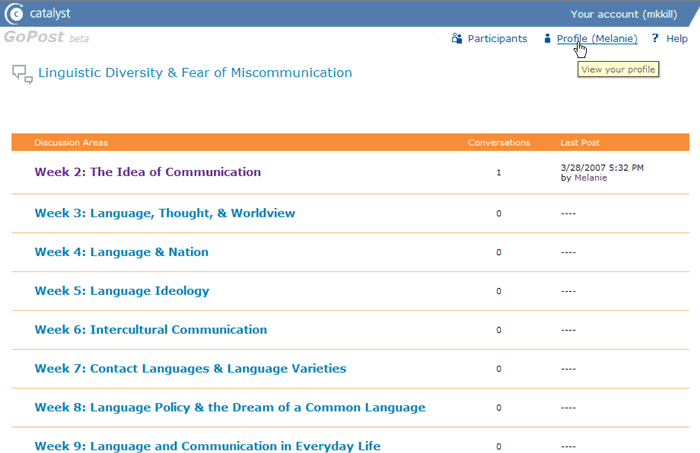
Click 'Profile' in the upper-right corner of the screen and then 'edit profile' in the upper right corner of the orange box on the page that comes up. You have options about what information to add to your profile. At a minimum:
- change your 'screen name' to from your UW NetID to your first name
- add an email address that you check regularly
A picture in the 'avatar' field is also helpful for learning names and carrying conversation back and forth from the discussion board and class.
To access the week's readings
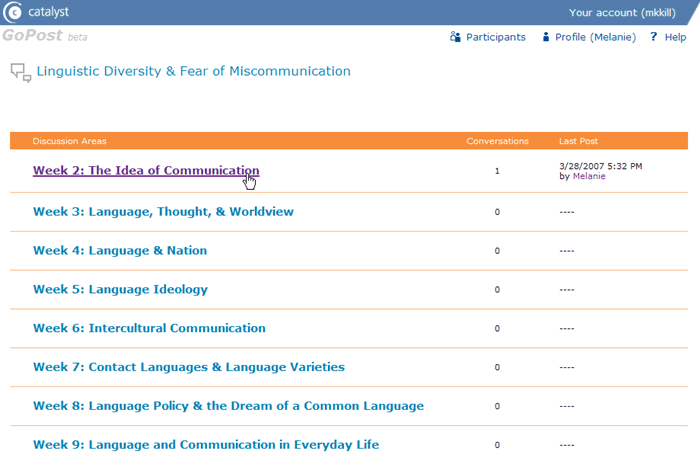
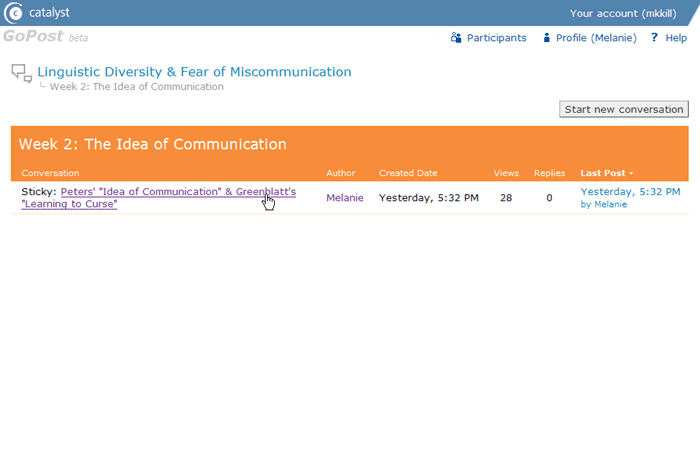
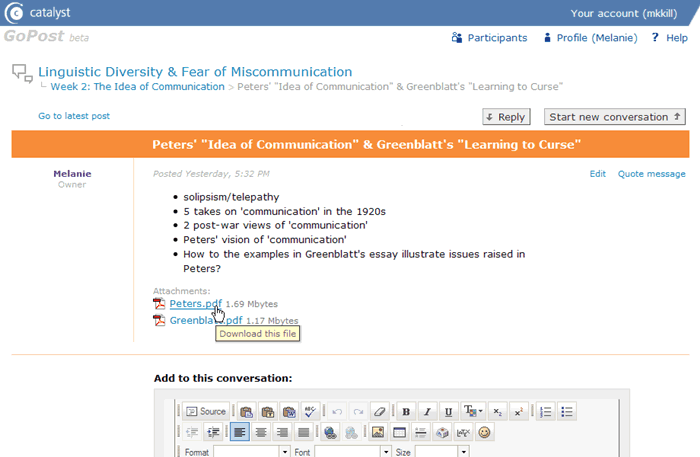
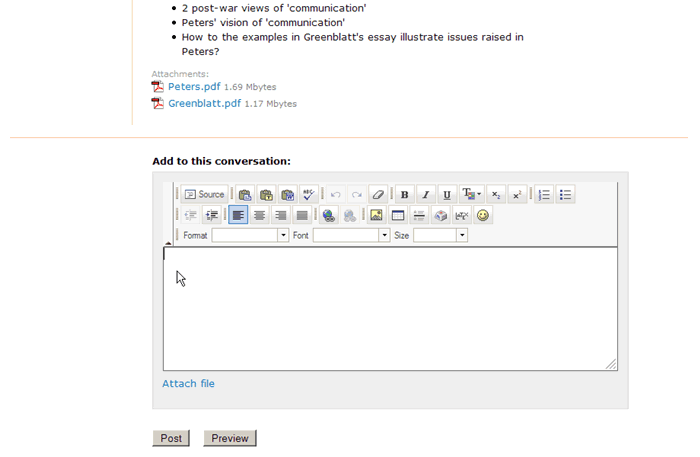
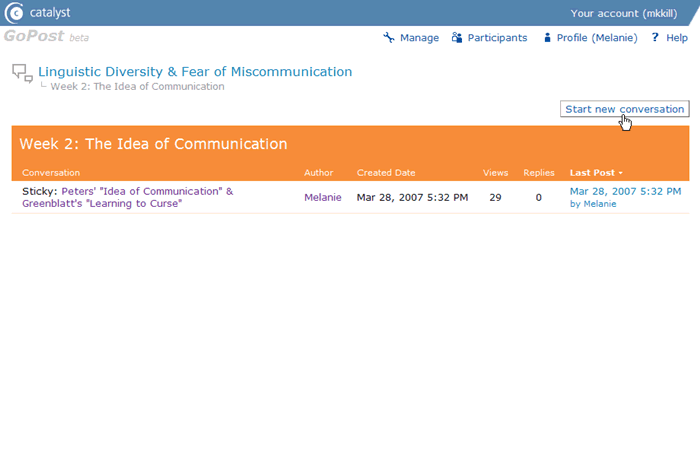
Click the discussion area for the week and then the conversation that I have started with the week's readings as the subject line. In the opening posting of this conversation, you will find a posting with the week's readings attached in pdf format (print these!) and a list of questions and/or topics from the readings that I'll expect you to be prepared to discuss when we meet. If you have questions for your classmates about the readings or want to share related ideas, please post in this conversation by replying in the 'Add to this conversation' field at the bottom of the page.
If it is your week to post a microessay
Start a new conversation in the week's discussion area using the name of your essay as the subject line and the essay as the body of your posting. Microessays must be posted by 9:00pm Sunday on the week due.
If it is not your week to post a microessay
Do not start any new conversations. Do add to the conversations started by that week's microessay posters, posting responses to two or more of your classmates' microessays by 9:00pm Tuesday.
Characteristics of effective postings
- Response posts should generally be no more than one to two thoughtfully-composed paragraphs. It is the quality of the message that I and your classmates will be looking for, not the quantity.
- Be sure your name is on each of your posts. If people have to work to connect an unfamiliar screen name to the person they know in class it is much harder to carry discussion topics and ideas back and forth between the discussion board and the classroom. (Filling in your profile information is also good for facilitating contact with your classmates.)
- Post on time. Discussion topics will inform class discussion and so posting and reading the discussion board will be crucial and time-sensitive preparation for engaged in-class participation.
- Choose your words and phrase your sentences thoughtfully. Online communication lacks the non-verbal cues that provide much of the meaning in face-to-face conversations, so after you draft your posting please read back through what you've written. Please be professional and courteous.
- Proofread. It is good practice to compose a message in a word processing program, use the grammar and spell-check, and then cut and paste to post it to the discussion board. (This also guards against you ever having to re-compose a message if an error occurs when you click 'Post'.)
- Reduce reply quotations. To avoid stretching out the conversation unnecessarily, when you quote an earlier posting, edit it down to just what is necessary to act as context for your reply.

Microessays
printer-friendly version
class-generated advice
The Task
A microessay is a highly compact single-spaced, single page essay (500-600 words). The idea behind the microessay is to grab some things that interest you from the readings and throw yourself into articulating a specific question, idea, and/or concern that they brought to your attention. Your paper should respond to a major or minor theme of the course, address readings from the week during which you submit, and demonstrate your ability to think critically about the readings.
Three times over the course of the quarter you will post a microessay to our course discussion board in advance of class meetings in order to:
- delineate a field of inquiry and establish a point of entry for class discussions and activities
- generate a range of potential lines of inquiry that you or your peers might pursue in your term project
A few words of advice
- Begin with a line of inquiry that develops out of what you find interesting, wrong-headed, surprising, or thought-provoking about the readings you've done. But don't stop with an evaluation.
- Be sure it will be clear to readers what specific question, idea, and/or concern you are addressing.
- Don't waste precious page-space summarizing. It is very important that you demonstrate understanding of others' ideas and positions adequate for your purposes, but your focus should be on what you can do with the ideas others have brought to your attention.
- Don't be fooled by the length; this will take time to do well! A short essay requires you not only to put thought and energy into exploring ideas but also into carefully revising and editing to maximize the effectiveness of your writing in a concise form.
Formatting and documentation
- 500-600 words
- All sources not assigned for this course must be cited both in the text and in a bibliography following your essay so that your reader can locate your sources. (MLA is standard in my field, but as long as you document your sources clearly and consistently you may use whatever system you prefer.)
Evaluation
At the end of the quarter, when you submit revisions of your microessays, they will be evaluated according to how well they meet the following set of criteria:
- The discussion is appropriately complex, addressing the questions of the course with new insight and ideas provided by the week's readings.
- The stakes of the discussion—that is, why the question, idea, and/or concern is worth addressing—are articulated and persuasive.
- The discussion involves close scrutiny and examination of assumptions and textual evidence in support of a larger set of ideas.
- The writing is intertextual, meaning that a "conversation" between texts and ideas is created in support of the writer's goals.
- The writing displays a clear understanding of its audience, and various aspects of the writing (mode of inquiry, content, structure, evidence, appeals, tone, sentences, and word choice) address and are strategically pitched to that audience.
Sample microessays
These are from a literature course, but they should help you get the idea.
Timeline
- Weekend before your week: Write and post microessay by 9pm Sunday.
- After Monday's class: You have the option to revise/edit microessay on the discussion board before you receive the bulk of your feedback.
- After Wednesday's class: Read discussion board feedback, consider class discussion/activities, review readings, and do a thorough revision while your thinking is fresh.
- Nearing the end of the quarter: Considering everything you have learned and thought about this quarter, as well as feedback from your writing group, do a thoughtful final revision and careful editing to prepare two microessays for submission as part of your final portfolio.
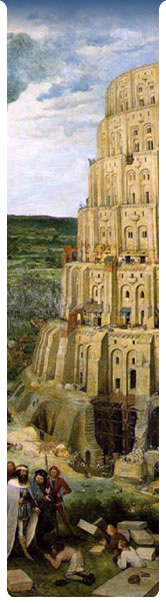
Project Babel
printer-friendly version
The Background
The New London Group, an international collaboration of literacy scholars, makes two arguments about what it means to be literate in the contemporary world:
- "Effective citizenship and productive work now require that we interact effectively using multiple languages, multiple Englishes, and communication patterns that more frequently cross cultural, community, and national boundaries" (6).
- "Meaning is made in ways that are increasingly multimodal - in which written-linguistic modes of meaning are part and parcel of visual, audio, and spatial patterns of meaning" (5).
This project invites you to exercise your literacy in a way that takes up language and other modes of meaning-making as "dynamic representational resources, constantly being remade by their users as they work to achieve their various cultural purposes" (5).
Elements of meaning design
- Linguistic meaning: e.g., text, voice over
- Visual meaning: e.g., images, page layouts, screen formats
- Audio meaning: e.g., music, sound effects
- Gestural meaning: e.g., body language
- Spatial meaning: e.g., environmental spaces, architectural spaces
- Multimodal meaning: i.e., relationships between any and/or all the five above
The Task
Drawing on your individual linguistic repertoire and modes of communication including (but not limited to) those listed above, you will design and produce a multimodal composition that
- falls somewhere in the mixed-genre territory of essay, research project, and creative work, and
- directs your response to a particular line of inquiry (spurred by the larger inquiry of this class) to a public audience.
The product will be multimodal, meaning it must engage its audience with a coordination of multiple channels of communication (i.e., linguistic, visual, audio, gestural, spatial, etc.). It also must be made accessible to the public, published online or otherwise publicly displayed.
Possible forms
- Option 1: Video Essay
- Option 2: Hypertext Essay
- Option 3: Art (Annotated)
- Option 4: you choose
Collaboration
This is an individual project that will be workshopped and developed in close collaboration with a team of classmates.
Where to start
- What issue(s) from this class do you most want to pursue? What ideas or problems have you had a strong reaction to?
- What language varieties do you speak or want to develop/experiment with?
- What artistic/creative abilities to you have or want to develop/experiment with?
- What technical skills do you have or want to develop/experiment with?
- How might you bring these interests and abilities together in a way that would engage a public audience with the thinking/learning you are doing for this course?
Timeline
30 Apr 07
- Project proposal due
07 May 07
- Initial draft / mock-up due
This should be as complete as possible a plan for your project, meaning you should locate as many of the resources/materials you will use, sketch out any visual components (e.g., make up a story board, sketch your page layout, etc.), and draft the written components of your work. It is in your best interest not yet to begin anything that would be overly time consuming to re-do as you still need to be in a position to be responsive to feedback from your group members.
21 May 07
- Complete draft / working prototype due
30 May 07
- Revised draft / advanced prototype due as part of complete draft of final portfolio
06 Jun 07
- Final version due as part of final portfolio
If your work is physically displayed somewhere, you will submit accompanying texts (artist's statement, annotation of the work) and photos of the work in public. If your work is online you will submit the URL and zipped files.
Resources
equipment for loan & free software:
- Windows Movie Maker 2.1
Windows Movie Maker allows you to edit video. - RealProducer Basic
RealProducer Basic is for users who want to create high-quality RealAudio and RealVideo, but don't need advanced professional features. - Photo Story 3
Photo Story is a Microsoft program that allows you to make digital photos into slideshows with voice narration and soundtracks. - GIMP
GIMP stands for the GNU Image Manipulation Program and is a freely distributed piece of software for such tasks as photo retouching, image composition and image authoring. - Blender
Blender is open source software for 3D modeling, animation, rendering, post-production, interactive creation and playback. - Audacity
Audacity is open source software for recording and editing sounds. - HTML-Kit Download
HTML-Kit is a full-featured, highly customizable and free web development environment that can be used to create, edit, validate, preview and publish web pages and scripts. - HTML-Kit Plugins Download
You can download plugins that add features to HTML-Kit from this page. I recommend HTML Tidy and Spell Checker to get you started. - HTML-Kit Tutorial
This is a very basic tutorial that should help you find your way around in HTML-Kit.
images
blog or website
- Blogger.com
- LiveJournal
- Catalyst SimpleSite
This is a UW Catalyst tool that allows you to create template-based web pages and publish them to your website without having to learn HTML. - ELATED
Elated pagekits are complete and free website templates.
They require just enough understanding of HTML to figure out where paste in your text, urls, and image paths (see below). - see HTML-Kit under free software above
How-to info
- UW Streaming Media Services
- YouTube: Making, Uploading, and Promoting Videos
- Creating a Student Home Page
Instructions for setting up a website on a UW server. - Introduction to Hypertext Markup Language
This hands-on workshop is designed to introduce you to the fundamental concepts behind Hypertext Markup Language (HTML). You will learn how to create, present and maintain your own website. Topics include creating and posting web pages, changing fonts, inserting images, using hyperlinks, and creating tables. - HTML + Cascading Style Sheets
All of the newer Elated pagekits use Cascading Style Sheets (CSS) to control the presentation (font styling, layout, backgrounds, etc.) of the HTML document. If you are content with the design, you won't need this, but you might want to take a look just to understand more about how the pagekit works.
Apologia
printer-friendly version
Overview
An apologia is not an apology (the words are false cognates) but an explanation and justification of one's actions. It addresses the justness or appropriateness of choices one has made, presented in the context of explicit principles and ideals to which one declares adherence. It also implies the existence of a body of people on whom one's actions have influence and impact, as well as an audience in the position to judge the quality and candor of one's self-analysis and to compare it to their own perceptions.
The Task
This reflective essay will show and tell how the work you are submitting in the final portfolio demonstrates that you have successfully met the following objectives for this course:
- Articulate a multifaceted understanding of the idea of communication
- Display rhetorical skill as a responsive and resourceful designer of meaning in multimodal and multilinguistic contexts
- Formulate questions and lines of inquiry that 1) synthesize or integrate different perspectives and approaches to constructing knowledge and 2) cultivate critical awareness of the ethical, cultural, and political dimensions of the ideas you encounter and explore
- Employ skills and strategies for effective collaboration as a learner, researcher, and teacher
- Address different audiences and contexts effectively, in speech and writing, both within and outside the classroom
- Articulate and assess the effects of the choices you and others (peers, scholars, and authors) make in writing and creative work
* * * An effective apologia will show your mastery of these objectives both by demonstrating them and by indicating where particular elements of your final portfolio demonstrate the objectives. * * *
Consider the following questions as you write:
- How can I demonstrate success with this objective in my writing?
- What work am I presenting in this portfolio that demonstrates my success with this objective and how does it do so?
Keep in mind that this is an essay, not just a list of evidence. I recommend framing the essay as a discussion of your learning about linguistic diversity / fear of miscommunication and structuring it to mirror your arrangement of the components of the portfolio.
Format
2-3 single-spaced pages, 12 point Times New Roman, 1 inch margins
Final Portfolio
printer-friendly version
Components
- Apologia
Submit one .doc or .pdf file. The essay should be 2-3 single-spaced pages in 12 point Times New Roman font with 1-1.25 inch margins. For full description see above. - 2 representative discussion board responses
Submit one .doc file or two .pdf files. EITHER: Cut and paste 2 discussion board responses into a .doc (or .txt) file. OR: Highlight the text of your response on the discussion board and Print > Selection into a .pdf. - 2-1 revised Microessays
Submit one to two .doc or .pdf files. Each revised microessay should fit on one single-spaced page in 12 point Times New Roman font with 1-1.25 inch margins. For full description see above. - Project Babel cover sheet
Aim to be thoughtful but concise in your responses. - Project Babel
The number and type of files you submit will depend on the format of your project. Any stable version of your work that can be submitted digitally should be submitted. For example, if your project is . . . - a website: zip all site files (.html, .css, .jpg, .gif, etc.) and submit .zip file (.zip help)
- a blog or Wikipedia entry: from your browser print (or otherwise convert) page(s) to .pdf and submit (.pdf help)
- a video: submit in a streaming media format (streaming help)
- art or another physical object: submit artist's statement (if art) in .doc or .pdf, annotation page in .doc or .pdf, and 5-7 photos of your project in detail and on public display in .jpg or another image format.
Evaluation
A successful final portfolio will demonstrate your achievement of the course objectives according to the following scale.
Outstanding Portfolio 3.7-4.0
This portfolio exhibits outstanding proficiency in all course objectives. All portfolio components creatively and thoughtfully exceed the basic requirements of the assignments. The apologia provides evidence of mastery of the course objectives clearly and with specificity. In this manner, it displays thorough and thoughtful awareness of the work on which it reflects, supporting and contextualizing the claims and assertions made with evidence from the course readings, class discussions, and prior assignments/activities by quoting or paraphrasing from these materials. The outstanding portfolio consistently demonstrates appropriate and strategic risk-taking, originality, variety, and/or creativity.
Strong Portfolio 3.1-3.6
The strong portfolio exhibits strengths clearly outweighing weaknesses, but may show somewhat less proficiency in some element of the course objectives. The apologia indicates clearly and with specificity where items in the portfolio demonstrate the course objectives. It also displays thoughtful awareness of the work on which it reflects, supporting and contextualizing claims and assertions with evidence from the course readings, class discussions, and prior assignments/activities by quoting or paraphrasing from these materials, but may not present as clear an argument for writing choices as the outstanding portfolio. This portfolio engages the course concepts and is highly successful with all assignments, but may risk less than the outstanding portfolio.
Good Portfolio 2.5-3.0
The good portfolio also exhibits strengths outweighing weaknesses, but shows less strength in some element of the course objectives. The apologia indicates where items in the portfolio demonstrate the course objectives, but may display less thoughtful awareness of the work presented by less effectively using evidence from the course readings, class discussions, and prior assignments/activities in support of its argument. The portfolio usually will not display the appropriate risk-taking and creativity of the strong and outstanding portfolios.
Acceptable Portfolio 2.0-2.4
The acceptable portfolio is competent, demonstrating that the course goals are basically met, but the ability to discuss the work is not as fully realized or controlled. The strengths and weaknesses are about evenly balanced. Some parts of the work presented may be underdeveloped, general, predictable, or leave relevant course concepts unconsidered. The apologia indicates where components of the portfolio demonstrate the course objectives, but likely draws less on evidence from the course readings, class discussions, and prior assignments/activities. There may be moments of excellence, but in general the portfolio simply meets the basic requirements of the course.
Inadequate Portfolio 1.0-1.9
A portfolio will be inadequate when it shows serious deficiencies in any of the course objectives. The apologia may be brief and may not indicate which items in the portfolio demonstrate specific course outcomes or make an effective argument for how they do so. The portfolio may show effort, but does not demonstrate success with the goals of the course.
Incomplete Portfolio 0.0-0.9
The incomplete portfolio covers the range, from no portfolio turned in (0.0), to a portfolio missing significant portions of the required work, to a portfolio including incomplete assignments.