Pharmaceutical treatment of osteoporosis


ESTABLISHED TREATMENT OF ESTABLISHED OSTEOPOROSIS EXPERIMENTAL THERAPIES

ALGORITHMS


When to add medications

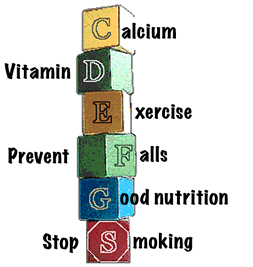
Physicians must pay attention to basic prevention before writing a prescription. Medications do not work as well (if at all) in patients who have poor nutrition, vitamin D deficiency, or lack of exercise. In frail women and men, hip protection should be part of the plan. Patients with secondary osteoporosis may require different treatments from those that are useful for primary osteoporosis.

Addition of pharmaceutical treatment should be based on the risk of fracture. Using the bone density, age, presence of fracture, other risk factors, and general health, a risk of fracture can be estimated, using the Fracture Risk Calculator.

Risk of fracture Example Drug choices
in addition to basic prevention
Hip fracture
in 5 yr
Lifetime
hip fracture
Low 13% Young strong woman, no risksnone
Low27% Young woman with osteopenia, no riskswait until menopause for treatment
Below 1%27% Early postmenopausal woman, T-score -2uncertain, see choices
1%21% 60 yr old woman, osteopenia (T-score -1.5) none
4%40% Healthy 67 yr old woman, T-score -2.8, no other risks or fracturesraloxifene, bisphosphonate, calcitonin
2%27% 65 yr old woman, T-score -2, weight less than 125raloxifene, calcitonin, bisphosphonate
8%39% 72 yr old woman with T-score -2.8 and vertebral fracturebisphosphonate, raloxifene, calcitonin
3%20% 85 yr old woman with T-score -1.5, no fracturesnone
MediumHigh 45 yr old man with hypogonadismtestosterone
MediumMedium 50 yr old man with kidney stone, hypercalciuria and osteopeniathiazide
6%40% 65 yr old woman or man with T-score -3 with vertebral fracture while on treatmentintermittent PTH
HighHigh Patient with heart transplantspecialized treatment
HighHigh Patient with hypocalcemia and intestinal bypass calcitriol
HighHigh Premenopausal woman taking steroids individualize treatment

Comments

Women or men with vertebral fractures need therapy Medical treatment should be given to prevent further bone loss and to reduce the risk of more fractures. These patients are at high risk and they benefit from potent medications. With the information available today, there is no excuse to ignore this condition. The high short-term risk outweighs the potential long-term side effects of treatment.
BisphosphonatesBisphosphonates have been approved by the FDA for prevention of osteoporosis, and they are widely used in women younger than 65. However, I am reluctant to use them in young or low-risk women, and reserve these drugs for those with established osteoporosis or those with osteoporosis taking prednisone. I have a more conservative view about long-term safety issues than many other physicians, perhaps because I have a physiological perspective. Bone biopsies from patients taking bisphosphonates show 95% reduction in the bone formation rate, so I usually stop after 5 years of treatment.

The bisphosphonates get deposited in the bone and will accumulate for years. It is possible that many years of continuous medicine would make bone more brittle or impair the ability to repair damage. Bisphosphonates do reduce fractures and improve measurements of bone strength for the first five years in both animal studies and in women who have osteoporosis. After 5 years, the fracture rates are as high in the women who keep taking alendronate as in the women who quit.

Other anti-resorbing agents Estrogen, calcitonin, and raloxifene also are anti-resorbing medicines. They do not accumulate, and on bone biopsies the bone formation is similar to pre-menopausal levels. Estrogen has been shown to continually maintain bone strength for 30 years - it is the only medication with such a long track record. Estrogen also has been shown to prevent osteoporotic fractures, including hip fractures, in a large randomized study. However, if combination hormones (estrogen plus progestin) are started in women ten or more years beyond menopause there is an increased risk of heart disease and breast cancer. In women older than 60 who are started on estrogen only (no progestin) there was no increased risk of heart disease or breast cancer but there were more strokes. These risks were not seen in women who were within ten years of menopause. I think it is still reasonable to use estrogen in perimenopausal women with bone density in the bottom 10 to 15% of the population, because they have a low baseline risk of heart or breast disease and a high lifetime fracture risk. After 5 to 10 years, it may be best to switch to another medication such as raloxifene to minimize the risk of breast cancer that may occur with long-term estrogen.
Healthy premenopausal women I do not recommend any drug therapy, even if they have osteopenia (remember, by definition 16% of 25-year-old women have osteopenia). Nothing has been shown to be effective, and all drugs have risks. These young women should get calcium and exercise and avoid weight loss. However, if they have amenorrhea or oligomenorrhea they need estrogen, such as birth control pills with at least 35 mcg of estinyl estradiol. Depo-provera appears to enhance bone loss and should be avoided in women with high risk of osteoporosis.

Bisphosphonates should NOT be given to women who are planning to get pregnant.
Diagnosis Before beginning treatment, a diagnostic workup should be done to be sure that the disease is primary osteoporosis. Patients with secondary osteoporosis may require more specific therapy.
Follow-up Whichever treatment is chosen, physicians should be aware that follow-up bone density tests are not completely reproducible. Even a slight loss of bone density could represent an acutal gain, and could mean that the patient was responding. Repeating the bone density in a year can give a longer-term picture. In cases of high risk, bone markers might help to decide if the therapy is working when the bone density is borderline.

Updated 12/07/05